Why most business advice isn’t designed for creative businesses
There’s a lot of really great business advice out there, but I’ve worked with many creatives who have struggled to find advice that actually suits how they work. Often, this leaves them wondering if they’re doing something wrong. Or that they’re just not cut out for running a business.
It’s not that the majority of business advice is wrong, but it’s usually geared towards linear businesses with predictable capacity and growth models that prioritise scale over passion and sustainability.
Over the last few years, I’ve spent a lot of time understanding how I work, and I see the same patterns coming up again and again with the creatives I work with. I’ve had to figure out which tools genuinely suit my creative brain. I have also spent time understanding why so much of the advice out there didn’t work for me. And this has helped me find a more flexible and realistic way of working on my business.
There are a few reasons why traditional business advice often misses the mark for creatives, and once you see them it becomes a lot easier to figure out what works for you.
Creative work rarely follows a neat, linear path
If you’ve ever felt like you’re constantly iterating rather than “finishing”, this is probably why. Creatives problem solve, which is an incredibly valuable skill for all businesses. But where traditional advice is to have an outcome-led approach like this:

Creative thinking is more adaptable and circular, with a learning-led approach:
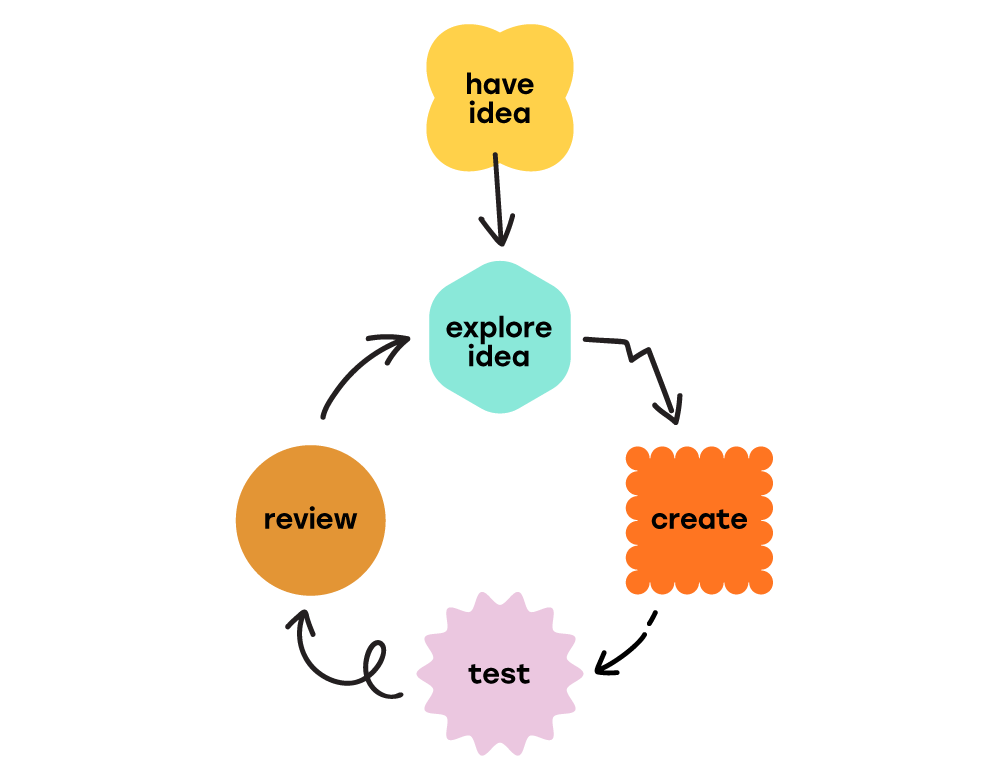
The first approach is about proving a plan works. The second is about figuring out what works as you go.
In my experience, that can make many creative business owners feel like they’re never achieving because they’re constantly iterating and pivoting what they do. But in reality, it makes us adaptable and agile. This is actually a great way to run your business because it means you can move quickly and stay on top of changing trends and needs.
Seeing how your creative thinking is a benefit in the world of business, and working with it not against it, can make you versatile and resilient in more turbulent times.
Creative businesses don’t make money in the same way
We’ve all heard the advice that a ‘solid, profitable business’ creates predictable, recurring revenue. This can feel difficult for many creatives because the way we work is often project based or involves creating custom work.
One of the biggest challenges I’ve seen for creatives is figuring out how to make their income predictable and consistent. This commonly leads to feeling like you’re constantly in survival mode, so you end up saying yes to whatever comes your way, or not taking a decent wage from your business.
Instead of changing the way you work, we creatives need a strategy for dealing with our way of working. That means understanding finances to plan for the ‘lulls’ and having multiple ways to earn income to support us through seasonal changes.
Creativity doesn’t neatly fit into an 8 hour day
Another challenge many creative businesses face is that creativity doesn’t fit into a 9-5 schedule. In fact, trying to fit yourself into this way of working can often feel stifling. I’ve lost count of the times my clients have beaten themselves up for not being able to fit themselves into a ‘standard’ workday.
We’ve been taught our whole lives to fit into the standard working week, but flashes of creativity come at the most random times. I definitely struggled when I was a designer in an agency having to force creative ideas on days when they just didn’t come, only to find I’d get home and my brain would kick into gear.
Since becoming self-employed and doing a lot of reflective work as a coach, I’ve learnt a lot about myself and the way I work - which has transformed the way I view my working week. It’s not about fitting yourself into the prescribed way of working - it’s about finding the right way that works for you. After all, if you are a single owner business, you don’t have to fit into a neat little work-week.
The advice to ‘optimise and niche’ often misses the mark
And on the subject of fitting yourself into a box…
Two of the most common questions I get asked are:
How can I find my niche when I do multiple things? and
I’m struggling with the idea of niching because I love what I do because it’s varied.
The very nature of creativity is to try new things and explore, so the concept of optimising what you do by niching to one thing often doesn’t sit well when you’re running a creative business. On top of that, most creatives I’ve met like to change how they work and what they do for variety. Their creativity comes because they enjoy doing multiple things.
The value that creativity brings to all businesses is important - and this is something that can be harnessed by us. It’s about finding a way to make the money you want in a sustainable way.
Instead of trying to optimize by fitting yourself into a restrictive box, focusing on the value you bring can carve out your ‘niche’ and help you to build a sustainable creative business that enables you to develop new offers or services without feeling restricted or stifled.
Success doesn’t just mean growth and profit
Many creatives start their business to be creative, and scaling often isn’t on the agenda. We see a lot about business success equaling growth and profit. Growth is even constantly in the news when it comes to the economy. So there’s no wonder we can feel disheartened when we can’t see how our business can be set up to be ‘successful’.
What’s really at play here is our definition of success. That’s why I always bring my clients back to their ‘why’ every 90 days - because it reminds them of what success looks like for them.
When you redefine success, it makes it easier to make decisions about where to focus your efforts in your business. But it also shows you where you’re actually doing really well - and it often surprises people how successful they actually are!
Planning too far ahead often backfires
Traditional business planning often asks you to set out where you want to be in 5 years time. But planning this way can feel restrictive. And if you want to deviate from the plan, it can and feel like you’re ‘failing’.
I’ll hold my hands up - I’ve never had a 5 year plan and don’t intend to because my business has evolved with my interests. My creative mind means I like to follow what I enjoy and don’t want to be restricted to something I set out 2 years ago which doesn’t fit with my life anymore.
That said, having a plan is beneficial for creatives because without some form of structure, we do tend to meander and find ourselves down multiple paths at once without any clear focus. But, it’s about finding a way of planning that works for you, and often, planning with each season helps to support creativity instead of limiting it.
When you start to look at business advice through this lens, a lot of the frustration makes sense. It isn’t that creatives are bad at business. It’s just that much of the advice out there was never designed with creative thinking in mind.
The good news is that there is business advice that works for creatives. It just starts from a different place, and values things like flexibility, creativity, and sustainability alongside growth.
If this resonates, the next post looks at the kind of business advice that actually works for creatives, and why it feels so different to what’s usually out there.